


SOLDIER, SCHOLAR, STATESMAN
EX-CIA DIRECTOR DAVID PETRAEUS VISITS THE BERKSHIRES TO TALK IN THE MOUNT’S SUMMER SERIES
By Scott Edward Anderson
Photo Courtesy of David Petraeus
July2026

General David Petraeus, one of the most consequential military minds of our era, will take the stage at The Duffin Theater at Lenox Memorial Middle & High School on Thursday, August 6, as part of The Mount’s In Conversation with André Bernard series.
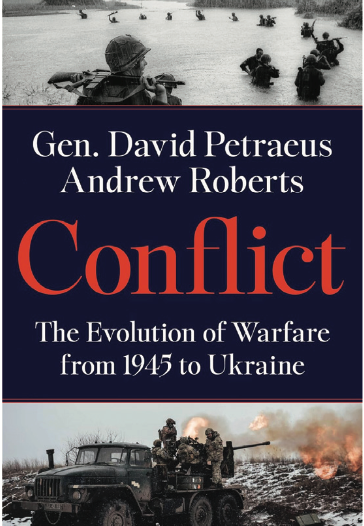
This four-star commander, co-author of Conflict: The Evolution of Warfare from 1945 to Gaza and now a partner at global investment firm KKR, will be in dialogue with André Bernard, former vice president of the Guggenheim Foundation. The acclaimed series, curated by Bernard, is designed to bring leading thinkers and influential voices into dialogue with curious audiences.
One question Bernard hopes to ask Petraeus is “given that warfare is increasingly conducted remotely and via electronic communication, how does the human element still factor in—and how does that change the nature of diplomacy, politics, and war?”
Expect the evening to move between grand strategy and personal reflection, between the drones over Kharkiv and the ski slopes above the Hudson, between what the United States must do in the world and what one extraordinary life in service has taught Petraeus about leading and, ultimately, about getting the big ideas right.
AN INTELLECTUAL WARRIOR
Petraeus grew up in the Hudson Valley, seven miles from West Point, on the other side of Storm King Mountain. When he was a young boy, he delivered newspapers to generals, colonels, and cadets. His high school soccer coach was a retired colonel who had guided the Army team to a national championship during World War II. His Sunday school teacher was a West Point ski coach. The military academy’s slopes were where the young Petraeus learned to race. In a sense, the arc of his life was charted before he ever walked through West Point’s gates as a cadet.
Petraeus likes to describe himself through an aspirational phrase he borrowed from General Jack Galvin, the NATO Supreme Allied Commander who was his mentor and model: “soldier, scholar, statesman.”
It’s a three-part standard that Petraeus has spent his career trying to meet; and by most measures, has exceeded.
“General Grant said the most important quality a commander can have is calm,” says Bernard, and Petraeus certainly has that quality about him. In conversation, he is striking for what he doesn’t do; he doesn’t raise his voice or reach for hyperbole, he speaks with the unhurried certainty of someone who has made decisions under fire: measured, precise, and without bluster.
According to Petraeus, his father was equally unflappable. A Dutch ship’s officer who was at sea when the Nazis occupied the Netherlands, he sailed his crew to Brooklyn rather than return home, and joined the building American Merchant Marine fleet before the U.S. had even entered the war. By age 29, his father was a captain in a merchant fleet that, Petraeus notes, suffered the highest per-capita losses of any service branch during World War II. He eventually settled in New York, met Petraeus’ mother in Brooklyn, and chose a quieter life ashore to keep his family together.
That lineage of courage and pragmatism runs through the family. Petraeus’ own son served as a rifle platoon leader with an airborne brigade in Afghanistan,
on the ground when his father arrived as commander. “There is no greater privilege,” Petraeus says, “than leading America’s sons and daughters in combat.”
A Princeton PhD, a Ranger School top graduate, and a 37-year combat veteran, his military résumé alone is staggering: six consecutive commands as a general officer, five of them in combat; commanding the Surge in Iraq, driving violence down by nearly 90 percent; and running all U.S. military operations in the Middle East as head of Central Command, as well as leading the 50-nation coalition fighting in Afghanistan. Add to that his appointment by President Obama to be the fourth CIA director by a Senate vote of 94 to 0. He served as director for 14 months and resigned in November 2012.
But what separates Petraeus from a purely operational commander is his insistence on the importance of ideas. In our conversation, he described what he calls the “four tasks of strategic leadership,” a framework he developed over years of command. The first task, he says, is the one that matters most: “Get the big ideas right.” Craft the right strategy, and everything else—communicating it, implementing it, and refining it—flows from that. “If you don’t get that right, your skill with the other three tasks doesn’t matter,” he says.
It is Vietnam that Petraeus returns to with particular intensity as a case study in how catastrophically strategic leadership can fail. “The U.S. military leadership failed for 13 years to get the big idea right,” he says. It wasn’t until late 1968, after the Tet Offensive had discredited the official optimism, after the “lights at the end of the tunnel” speeches had been exposed as hollow, that a new commander finally recognized what the mission actually required: “focusing on security of the people in hamlets and villages and districts, instead of chasing an elusive enemy around the rice paddies and islands and in triple-canopy jungle, just bombing the daylights out of anything.” Petraeus, who came of age as the Vietnam era closed and wrote his Princeton dissertation on its lessons, argues that by the time the new commander came on board, it was too late. He explores this at length in his book Conflict.
What haunts him is not the concern to repeat such conflicts, but the military’s institutional refusal to learn from them. In the wake of Vietnam, the services resolved to never again “train for, configure for, or even think about counterinsurgency.” Petraeus isn’t arguing against counterinsurgency; he’s arguing against willful unpreparedness. Iraq and Afghanistan proved, at great cost, that the military can’t simply opt out of wars that don’t suit its preferred force structure. “You don’t get to choose the wars you fight,” he observes, “you must prepare for the war as it actually exists, rather than the one you’d would prefer to wage.”
In Iraq, Petraeus inherited a strategy that was failing and replaced it with one built around protecting the population rather than chasing another elusive enemy.
This was a 180-degree shift that, he argues, ultimately changed the trajectory of the war. In Afghanistan, he watched a different kind of failure: a withdrawal he believes was premature and strategically misguided, a subject he explored in a long essay for The Atlantic in 2022.
THE WATERSHED MOMENT WE’RE LIVING THROUGH
Ask Petraeus what conflict he finds most compelling to think about right now, and he doesn’t pause. Ukraine.
“Ukraine is such a profound watershed in the nature of war,” he says. He has traveled to the front ten times. What he has seen there has sharpened a thesis he is now advancing across multiple publications: that the era of autonomous warfare has already arrived, and that the United States is not ready for it.
In a recent Foreign Affairs piece co-authored with Isaac Flanagan, Petraeus argues that the transformation unfolding in Ukraine’s skies and fields is not a distant military scenario, it is the present. Missions are already being executed by machines at speeds no human can match. Ukrainian forces have launched offensive operations conducted entirely with unmanned systems.
The lesson, Petraeus says, is stark: the side that solves the command-design problem for autonomous warfare first will hold a decisive advantage. The U.S. military, he warns, risks fielding what he calls “autonomous trinkets”—individual drones without the doctrine, concepts, or organizations to use them effectively— rather than building a genuinely autonomous fighting force.
He has written in The Hill about what he sees as a potential $55 billion Pentagon mistake and, prophetically, in the Wall Street Journal about the dangers of letting America’s recent success against Iran become a strategic distraction from the larger challenges ahead. These are not abstract think-piece concerns. For Petraeus, they are the big ideas that we need to get right, and we need to get them right, right now.
Since leaving government, Petraeus has built what he cheerfully describes as an improbably full second act. As a Partner at KKR and Chairman of the KKR Global Institute, he has watched the firm grow from $83 billion under management to well over $670 billion during his 13 years there. He serves as the Kissinger Fellow at Yale’s Jackson School, leading graduate seminars on great-power competition, continuing his scholarly pursuits. He is decorated by 14 foreign countries and is sanctioned, with some evident pride, by Russia.
He also turns out to be a frequent visitor to the Berkshires. Petraeus mentions, almost in passing, that he visits Lenox with his family each summer; they’ve toured The Mount, admired its survival from the Gilded Age, and have become quietly devoted to the area.
The talk with Petraeus promises to be an evening that stretches from the hills of the Hudson Valley to the drone-filled skies over eastern Ukraine; and from the lessons of Vietnam to the unsettled questions of tomorrow’s autonomous battlefield. His mix of candor and wit is part of what makes the prospect of hearing Petraeus in conversation so compelling. Bernard, who built his curatorial reputation at the Guggenheim and brought the In Conversation series to life at The Mount, has a gift for drawing out the person behind the public figure, and Petraeus has proven himself a willing and searching conversationalist.
In Conversation with André Bernard: General David H. Petraeus, Wednesday, August 6, 5-6 p.m., at The Duffin Theater at Lenox Memorial Middle & High School, 197 East St., Lenox. edithwharton.org/event


Comments