


Bunny Williams on Livable Luxury
MIX STYLES, INVEST IN A GOOD SOFA, AND MAKE IT PERSONAL
By Anastasia Stanmeyer
Photo by James Gillispie
Spring 2026
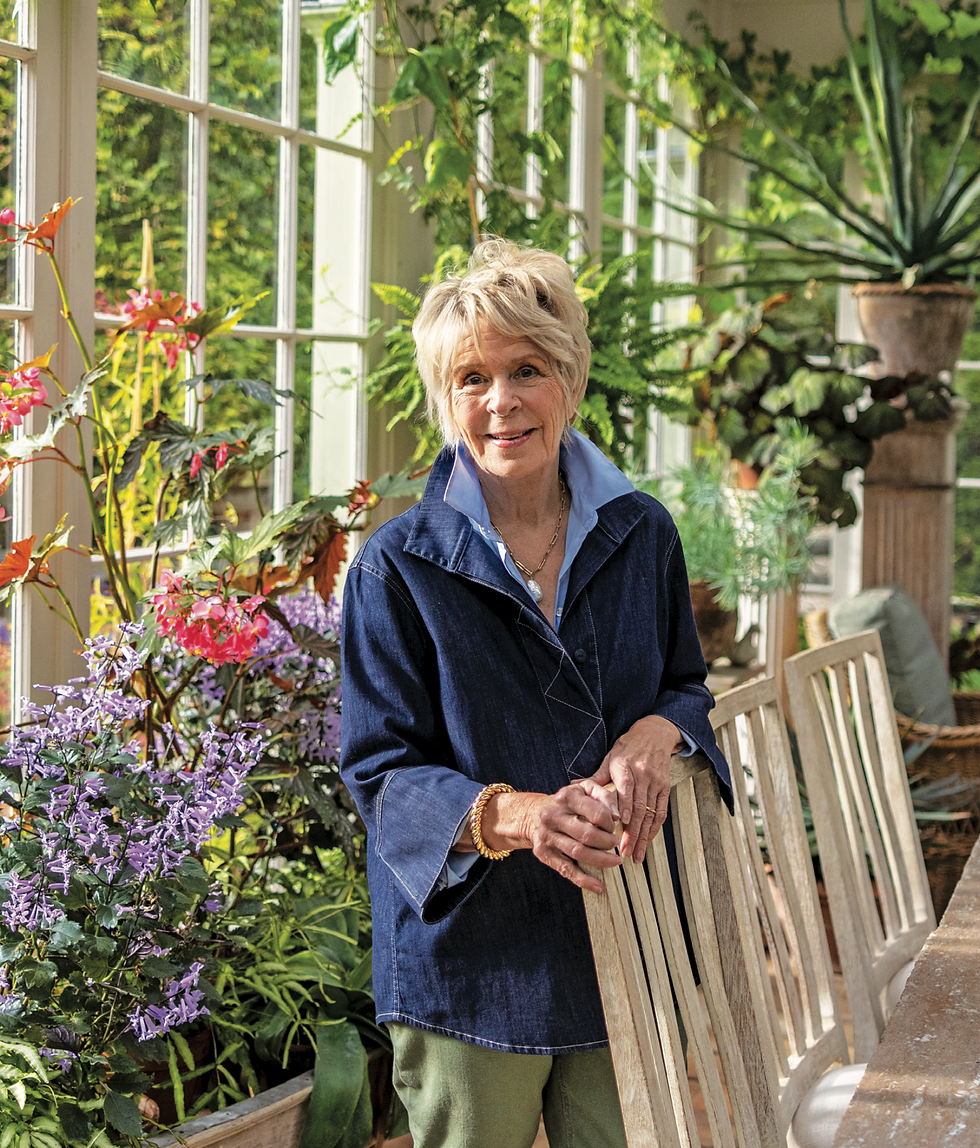
Bunny Williams is all about creating a home that is lived in and functional, with
each room inviting and comfortable—not precious and rarely used. And gardens require just as much planning and design, with added variables of adapting to the terrain and the amount of sunlight.
The interior designer, author, and entrepreneur will release her spring line through Bunny Williams Home on April 6, with an expanded outdoor collection of new teak and all-weather wicker styles, as well as planter boxes and pedestals.
“I’m always designing things that I need, and I love having pedestals becauseit gets plants at different heights, if you’re trying to stage them,” says Bunny. “If they’re all down on the same plane, you can build it up. So, I often design things that I would like to have in my own garden, and usually I bring them to my garden.”
She also has a new book on the horizon, Decoration, which she is co- authoring with Elizabeth Lawrence, who began working with Bunny 16 years ago as an intern. In May 2023, Bunny Williams Interior Design was rebranded Williams Lawrence to reflect their partnership. The book, which will be released in the fall by Rizzoli, illustrates work that each has done individually, as well as projects that they have done together.
“It’s not Decorating 101,” says Bunny. “What I hope people will do is look at it and be inspired even by a color or a light fixture or a detail, because a lot of the work is very grand and fancy houses. Whether it’s a garden or a home, you’ve got to look at the best you can. I learned about gardening by going to Europe, going to Sissinghurst, going to Great Dixter, going to gardens I will never have like that, and I was inspired by them. It’s always better to look at the best. You want to look at really good things. It helps to train your eye. From those things, you learn something. You pick up a detail or something that you know makes you feel good. And then you think, ‘Oh, I can try that.’”
Although she considers her exterior work truly for herself only and a hobby, Bunny is happy to offer advice based on her own experiences.
“To me, great gardens are about design,” she says. “If you just go buy some plants and stick them in a hole in the middle of the yard, that’s not a garden. You’ve got to start with the design, and that’s why going to look at the great gardens around the world is a good idea. It’s like a house. You have to get from one garden to another. What are your walkways? What are your paths? How does it flow? Whether it’s a quarter of an acre or 500 acres, there has to be a plan. And then you can choose the proper plants to fill in for the scale of the house and the light sources.”
Bunny began gardening at her 15-acre 19th-century Greek Revival property, which she and her husband call “The Manor,” in Falls Village, Connecticut, some 40 years ago. It is featured in Bunny Williams: Life in the Garden, whose photos appear on the following pages.
“My property is hilly,” says Bunny.“I started in the flattest area I could. Every weekend, I’d come from New York, go out in the garden, and I had these two huge perennial borders on the flat lawn. Then I realized it was sort of boring, and I started traveling and looking at things.”
Her gardens continuously evolved. Every time she had a little bit of money, she would do something else. They now consists of a sunken garden with a fishpond; a formal boxwood parterre garden; a woodland garden with a waterfall; a cutting and vegetable garden; an orchard and barn that includes a chicken coop; and a Birdhouse Village, home to Bunny’s collection of antique birdhouses.
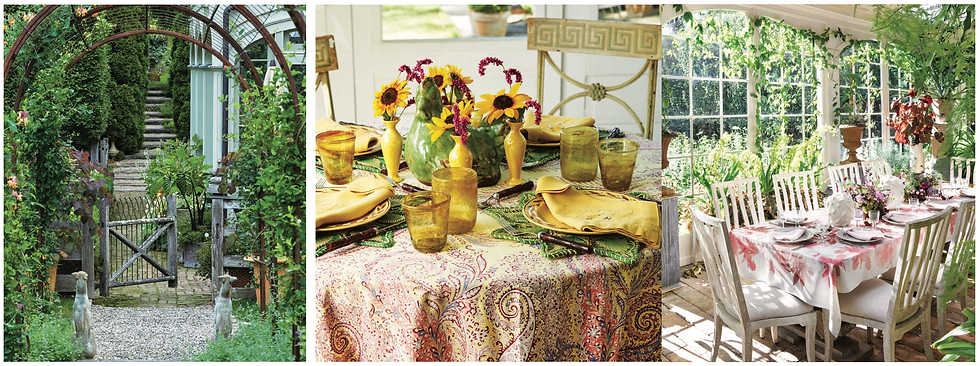
“There are all these kind of different gardens on this one property, but they fit the land,” says Bunny. “I always say that for your average home, if you go in one day a week and clean it, it’s going to be fine. The garden is seven days a week. It’s constant.”
There are principles from garden design that can apply to interior spaces, and vice versa. For instance, when you pull up to somebody’s house and you get out of the car, what does the walkway to the front door look like?
“If it’s a mess and weedy, it isn’t going to make any difference what happens when you open the front door,” says Bunny. “You’ve already made an impression. In my house in the country, everybody comes in the kitchen door. It’s just the way those old houses were; the driveways were on the side. So I had to make that a special area because when people walk in the door, that’s their first impression.”
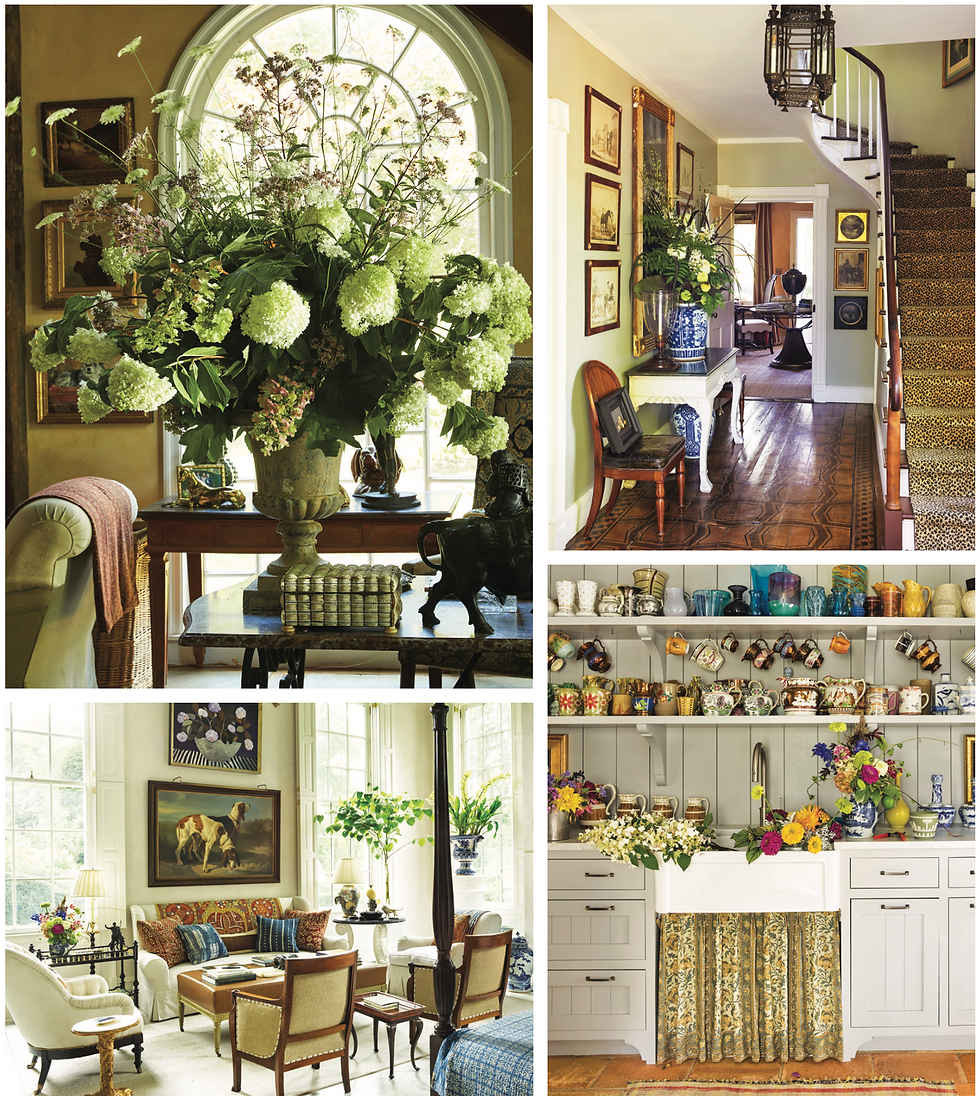
What’s her favorite part of her Connecticut home? Actually, all of it because every room is used, she says.
“I think you have to make yourself get out of the room where the TV is, but you have to have a reason to go there. If you do jigsaw puzzles, put the puzzle table in the living room,” she says. “I love to have people over. I like to cook, but I don’t like to cook all the time. I can go to Guido’s and get a dinner. And in the summer, I make a salad from my garden. There are so many local people making great bread, and that’s what’s fun. In the morning, I go to all these different places. And I like to eat in my dining room. Of course, we have breakfast in the kitchen, and my little great nephew comes for pancakes. But we really use our house. You have to set rooms up so that you’re not dragging everything to it. Somebody said, ‘You drink a lot.’ Well, not really, but if I’ve got a bar set up and somebody wants a Perrier, I don’t have to go to a cupboard and find it. I can say to people, ‘Help yourself, it’s right there.’”
What makes a room feel good is one that you use, says Bunny. “That’s why people always gravitate to the room in the house you use the most. You need comfortable furniture, you need a great floor plan, and, of course, with me, I’m always bringing in plants from the greenhouse, and they’re on tables. You need to make your room come alive.
“Accessories should only be because you love them. Some people don’t want any accessories, but you can still have a minimal room look cozy because somebody’s made the effort to cut a branch and put it in a glass vase. I want to feel that somebody’s been
in that room and made an effort. When I first bought this house 40-some years ago, I was at every tag sale and auction. It’s the most economical way to furnish your house, and it’s fun.”
Few things are so precious in her home that Bunny doesn’t use them, including fine china, which she loves to collect. The idea is to mix old and new; her dinner plates might be new, but the salad or dessert plates might be some of her finest antique china.
How does she approach color in designing for a client and for herself? “Color is personal. I’ve got to figure out what somebody’s color palette is first. Sometimes, you can tell by what they wear. Some people can only do blue and white, or some people can only do beige. I love color, and I love mixing odd color palettes. I don’t want a room with all primary colors. If the walls have a mellow color that don’t scream at you, then you can put bright colors with it or neutral colors. When you’re working for other people, it’s their personal feel for colors, and you have to figure that out. Often I ask clients, ‘Have you ever made a scrapbook of what you like?’ Of course, everybody has. Sometimes you get their Pinterest pictures, and it’s every kind of house in the whole world. So you then have to narrow it down. There’s a time for me to learn about the client, for the client to learn how we work, that I think is worth it in the end.”
Does she have a favorite color? “How can I have a favorite color? Look outside. It’s the blend of colors. It’s like my garden. It’s how you put them together that becomes interesting. That’s why I love doing flower arrangements, because I can make these interesting mixtures of colors.”
What are common mistakes people do when decorating their homes? “You really need to assess your house. You need to measure things. You have to get the scale right. I also find that people don’t know how to really arrange furniture. You’ll go in a room, and all the furniture is around the outside of the room. That’s not the way people talk to each other. If you have a sofa,you want some chairs around that sofa. You imagine six people are going to sit and talk to each other, and they need to be close to each other. And everywhere they sit, they need a little table to put their coffee or their glass of wine on. I don’t care what style I’m working in. To me, these principles make a room work and function. People will stick a chair over in the corner. Nobody’s going to go sit in that chair by themselves. So, I think it’s really getting the floor plan right and think, okay, if I’m going to have a big sofa or an L-shaped sofa, what kind of chairs, and balance the scale of the room. Sometimes, people get the scale wrong because they buy stuff online. It looks good there, but they haven’t figured out if it’s going to really work in their room.”
If there is one piece of furniture that’s worth the investment, it’s the sofa, says Bunny. “It can be re-covered, but it’s kind of a mainstay. It shouldn’t be too extreme. It shouldn’t be too big, because you might move. A good seven-foot long sofa is plenty big. A ten-foot-long sofa, where’s it going to fit? And can you move it? It should be comfortable to sit on, and maybe a couple of comfortable chairs. What’s great is to go and find the table to put next to the sofa, and the lamps. If people just go to tag sales and country fairs, it’s there. It’s so much fun.”
Bunny loves estate auctions, although it’s important to know a bit about the value of furniture before you bid. You might not find museum-quality furniture at country auctions, but you can find really good buys.
The industry has changed a lot, and one of the good things about it is that it’s grown, says Bunny. “There’s so much more out there. When I first started, you didn’t have big stores like Restoration Hardware or all these commercial stores. What’s sad to me is that because of the internet, everything’s gotten dumbed down. There are still inventive designers, but there’s a lot of work that is derivative. It all looks the same. My work gets copied all the time. And I’m, like, where’s your own idea? If you go shop, and you find unusual things to put in a room, that room isn’t going to look like anybody else’s. I always say people are going to have a very hard time copying a room I do. They might copy the color or whatever, but they’re not going to be able to find the furniture. They’ll find a sofa and the upholstered chair and maybe the fabric, but they’re not going to find what I call the personality things.”
Everyone evolves, and Bunny is no exception when it comes to her work. “When I first started out, it was very traditional, and now we’re doing much more contemporary work. I’ve gotten interested in contemporary art. I love mid-century furniture. It doesn’t mean I don’t love what I loved before. What I really love doing is mixing it all together. I don’t like a period of anything, and I love an antique cabinet that has a modern painting over it. My thing right now is how do I blend things? It’s mixing objects and textures to give something a unique personality.”
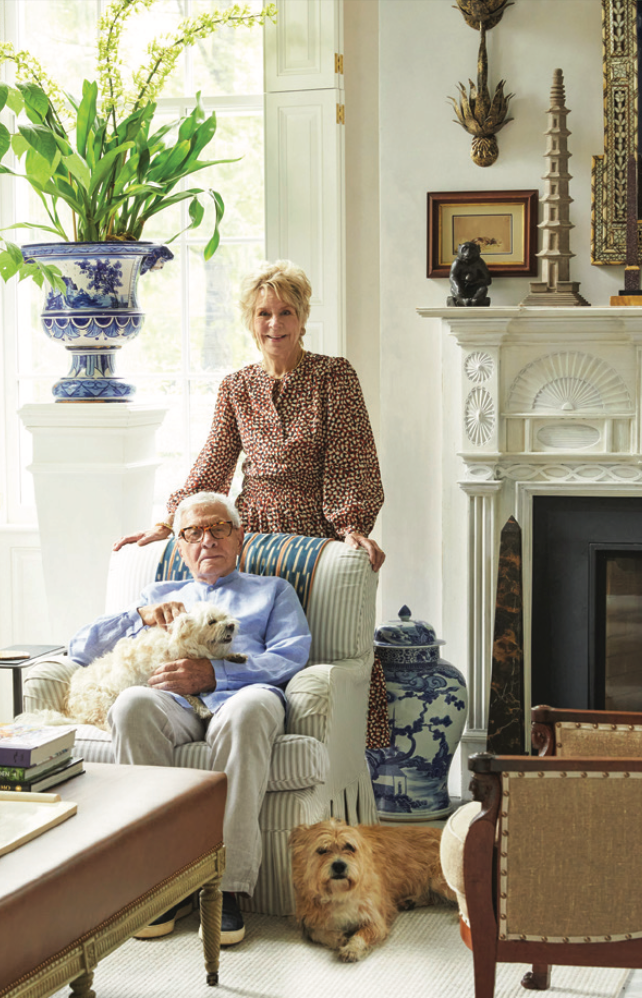
What is she reading these days? “I’m reading this wonderful book called Mona’s Eyes. It’s the story of a grandfather who’s taking his granddaughter who is maybe going blind to look at art in France. They live in Paris. He’s teaching her how to look at the paintings, and she’s learning history. So he talks about who painted it, how it was painted, and there are these stories of life in it. I love books like that.I don’t really look at a lot of garden design books anymore because I’ve got my own garden, and I’ve got to make it fit my spot. Before, I devoured Vita Sackville-West and Louise Beebe Wilder and all the garden writers. I was talking to my friend Page Dickey, and I thought, I really want to start growing dianthus, so I’ll go find a small book on how to grow dianthus. And I do read about native plants and invasives and more informative books rather than actual design.”
How did she find her profession? “I was very lucky to grow up in Charlottesville, Virginia. We grew up in the country, and on this road, Garth Road, were a lot of family members. In those days, everybody entertained. Albemarle County was dry. There were really no restaurants or bars, so people thought nothing of entertaining. I’d go to my Great Aunt Bertha’s for lunch on Sundays with the family. I’ve always loved homes. My mother loved her home. She loved to cook. She was kind of a frustrated decorator, and I’d go with her to the curtain lady. Southern women really owned their homes. They also cared about how they looked. My mother said you never go outside without some earrings and lipstick on. It was just in you. Then when I was a teenager, I went with my parents to see The Greenbrier Resort, which Dorothy Draper, this famous American decorator, had just done. Most of my family’s taste was pretty conservative. My parents had some friends who had invested in it, so we went to see it. Emerald green walls, white-plaster palm trees. It was wild. That’s when I really learned what an interior designer did. I was always artistic, and I fell in love with that. I didn’t want to go to a liberal arts college. I said, ‘I think I’d really like to do something in interior design.’I was never the greatest student, and I thought, what do I really want to study all this stuff for? So I went to a junior college. From very early on, it was something that I loved. I love furniture, I love homes. I was very lucky to get an extraordinary job eventually at Parish-Hadley, with the best education anybody in the world could have. In those days, they worked in the grandest, most fabulous houses in America. So I got to learn at the top, and it was kind of amazing.”
Bunny recommends that anyone new to the field should work for somebody. “But again, what’s so interesting is that people can create themselves on Instagram now. You want to be a designer? You can create yourself. I don’t know that you’ll be a great designer, but you will get work, and people will follow you. I came up the hard way. I didn’t start my own company until I was 44 years old. I wasn’t looking for fame when I was 25, because I worked at a firm where I knew I didn’t know what Mrs. Parish and Albert knew, andI saw the extraordinary houses they were working on. But I learned it and got a feel for it. Now, this next generation is, ‘Oh, I’m going to be an influencer and I’m going to be an interior designer.’ You can create yourself. It’s changed the industry. I think they’re more interested in being at home on their computer than going to look at stuff and experiencing things. It changes the intellectual, creative energy and the experience of it. You’ve got togo look at things if you’re going to do interesting work.”



10.0.0.254/admin does not open, verify that 10.0.0.254 is actually your router’s default gateway. Checking your device’s network settings can help confirm the correct administration address.
With rhythm-based action, creative level design, vibrant visuals, and nearly unlimited replay value, Geometry Game remains one of the most enjoyable arcade platformers available.
The material is comprehensive and easy to understand for retro games. I will be monitoring your subsequent posts on a regular basis.
Your hindi to english translation tool is one of the best I have used online. It is fast, simple, and gives natural English output instead of literal or awkward translations.
Excelente entrevista, muy inspiradora la forma en que Bunny Williams habla sobre el diseño, los jardines y la importancia de la escala y la armonía en los espacios. Me gustó mucho su enfoque en aprender observando lo mejor y aplicarlo a lo propio. También interesante el concepto de loteria ad como referencia creativa.