


The Legacy of Walter Cudnohufsky
From Shy Farm Boy to Renowned Landscape Architect
By Elise Linscott Gladstone
Photos by Michael Lavin Flower, Courtesy of Walter Cudnohufsky Associates, Inc.
Spring 2026

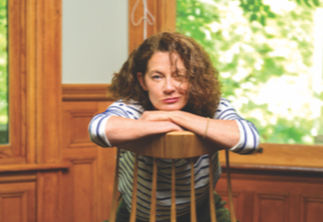
Growing up in southern Michigan, Walter Cudnohufsky was “a shy farm kid who loved making things grow and walking animals around at the county fair,” as he puts it. In order to truly like and accept himself, he made it a goal to overcome his shyness by teaching—and he’s found a myriad of ways to marry teaching into his career as a landscape architect and planner, and even as a painter.
Today, his local legacy includes founding the Conway School for Landscape Design in Northampton, where he also served as director from 1972 to 1992; starting a landscape design and planning firm based in Ashfield; and designing gardens and outdoor spaces for clients ranging from Shakespeare & Company to the Town of Great Barrington and private gardens around New England.
“I’m an unusual guy because I started out deciding as a sophomore in high school with a guidance counselor that I wanted to be a landscape architect,” he says. “And here I am a few years later, still acting as a landscape architect.”
His teaching philosophy, which is still in use at the Conway School today, is to be a learner as much as a teacher. That’s also how he overcame his shyness, by thinking of himself asa facilitator and co-learner at the school rather than labeling himself as a teacher. This is also an approach he’s enacted at his firm, Walter Cudnohufsky Associates, Inc. He is still an associate at the firm but handed over ownership to Chuck Schnell and Kirsten Baringer last April. Both Schnell and Baringer were graduates of the Conway School and have been working with Cudnohufsky for years.
“Walt’s influence on me is immeasurable,” Baringer says. “Though I have other influences and background and my own sensibilities, the school he founded opened to me the world of landscape architecture and planning.
“Walt is a consummate mentor who gave his employees a lot of space and responsibility in their work. I have not been on a project where he didn’t see opportunities to incorporate learning and reflection, for all parties involved. Under his tutelage, one is encouraged to ask questions and challenge assumptions, to think outside of the box.”

Schnell and Cudnohufsky also teach a horticulture certificate level two course at Berkshire Botanical Garden (BBG). Schnell used to accompany Cudnohufsky to the course as an assistant until Cudnohufsky asked Schnell to step in as lead teacher, with Cudnohufsky now making guest instructor appearances. (The next class begins on March 26; more information at berkshirebotanical.org.) The BBG course incorporates a shortened version of the design process they implement at the firm’s office for most of their projects, Schnell says.
“Most of it starts with asking the students at an early stage to identify their own values and whether they have design prejudices so that they know that going into any situation,” Schnell says.
The other piece of design that Schnell and Cudnohufsky teach students is to identify their feelings when seeing a particular site. At the firm, Cudnohufsky encourages his associates to note what they see and feel when pulling up to a site for the first time, encouraging themselves and their students to tune in to those sensory experiences.
“Really good architecture and garden design and landscape design spaces are not only visually appealing but also create some sort of an emotional response,” Schnell says. Greater self- knowledge is also one of the unspoken goals of the Conway School curriculum, he says, and one that helps students when they’re working on their own design projects.
Jenna O’Brien, owner of Viridissima Horticulture & Design, took Cudnohufsky’s course at BBG years ago and has since worked alongside him on projects in the Berkshires. She now teaches a horticulture certificate level one program at BBG, where she’s also a trustee. She’s always appreciated Cudnohufsky’s approach to design by honoring the landscape at large, as well as his out-of-the box approach to teaching. That includes driving students up north through New England to stop and look at gardens and landscapes along the way and talk about why they work or what they evoke.
Cudnohufsky himself seems to embody the philosophy that one can always be a learner. Now an accomplished watercolor painter, he started painting on a trip to Maine with a friend 35 years ago, when he was about 50. In the years since, he has taught workshops in watercolor technique up until the pandemic—and hopes to begin teaching again. He still displays his work annually as part of the Ashfield Fall Festival.
Several of his watercolors can also be found in the book he co-authored with Mollie Babize, titled Cultivating the Designer’s Mind: Principles and Process for Coherent Landscape Design.

Sometimes, Cudnohufsky’s role extends beyond just the plantings around a space. For some projects, he’s teamed up with architects like the Great Barrington-based firm Clark Green + Bek, to influence the overall design of the building as it goes through construction. Since their first collaboration on a client’s “dream home” in Lenox, Cudnohufsky’s team has done more than 200 projects partnering with the architectural firm.
“I love working in teamwork where the boundaries between architecture and landscape are blurred and where we’re not afraid to make suggestions about the building,” he says, citing the Lenox project in which his team “changed the whole footprint of the house and how we related it to the land.”
Overall, Cudnohufsky says he appreciates the varied aspects of being a landscape architect and artist.
“As a profession, you deal with not only aesthetics, but plants and nature and politics and finances and technical and artistic,” he says. “All those languages that go with those subjects get teased into the brain and become fodder. It’s a very expansive profession that also allows for inclusive community building and self-discovery.”
Further Reading (online exclusive):
Designing Your Home’s Landscape and Gardens
For the homeowner who wants an update to their exterior but doesn’t know where to start, landscape architect and planner Walter Cudnohufsky implores them to take note of their use patterns around the home and gardens and ask a few questions: Where in the yard have you not been? Why don't you go there? Where have you been the most? What time of year? How long do you stay? What gives you the greatest amount of joy? What do you look forward to seeing when you step out of the door? And what do you look at?
When my husband and I bought our home nearly two years ago, the landscaping looked like it hadn’t been touched in the 50 years since the house was built. The plants consisted mainly of overgrown shrubs around the perimeter of the house, along with several large, lovely rhododendrons that are covered with beautiful purple flowers in spring. While the rhododendrons were easy to identify as aspects we liked, we knew the rest needed work.
But the more I started thinking about Cudnohufsky’s questions, I realized that although the shrubs are overgrown, I like the two that frame the front steps. Certainly, they could be replaced with plants of a more appropriate size that are in proportion to the house and don’t block the edges of the windows on either side. This would preserve the welcoming feel of the greenery around the entrance to the house.
Cudnohufsky discourages clients from pointing to someone else’s yard and saying, “I want that.” Every homeowner’s needs are individual, even on the same street. For instance, one homeowner might have two kids while another doesn’t and would therefore have different uses for their yard. He encourages clients to work with the design teams on creating a plan for each project so that they can find a collaborative solution and plan to enact it, from small to large changes.
And while several firms work on multi-million dollar projects, many also do small-scale work for homeowners looking for advice. Even a few hours can be enough to make a difference and get homeowners’ wheels turning.
—Elise Linscott Gladstone


What a fascinating look at Walter Cudnohufsky’s journey—from a shy farm boy to a visionary landscape architect and educator. His philosophy of learning alongside students at the Conway School is truly inspiring. It reminds me how creative spaces, whether gardens or classrooms, thrive when they invite exploration. For teachers looking to bring nature and design into lessons, creating themed coloring pages can be a great tool—something I’ve found easy to do with resources like AIColoringPageGenerator.
What a lovely tribute to a man whose legacy is measured not just in gardens and buildings, but in the generations of designers he's mentored. I love the idea of approaching teaching as co-learning — it clearly shaped everyone who passed through his orbit, from the Conway School to his firm to the BBG courses. And the reminder to notice how a site makes you feel, not just how it looks, is one worth carrying into any creative work. Congratulations, Walt — and thanks for the reminder that we can always be learners, whether we're 20 or 50 or 90.👍
Muy buena información para quienes acostumbran revisar los sorteos diariamente. La posibilidad de consultar los resultados de forma sencilla ayuda a encontrar rápidamente los datos que interesan. Para complementar esta lectura, pueden consultar los números de hoy y revisar contenido relacionado con diferentes resultados.
What an interesting essay regarding Walter Cudnohufsky's impact on landscape architecture! His approach to merging nature and design roblox clicker truly speaks to me. I once worked on a project to establish community gardens in urban areas, and it's remarkable how intelligent planting can change a location.
I enjoy playing games on Free Online Games because of the relaxing gaming experience the platform offers. Additionally, its interface is very easy to view and navigate.