


A Whole Different Feeling
ZIGGY MARLEY ON HIS NEW ALBUM, HIS UPCOMING TANGLEWOOD CONCERT, AND THE POWER OF AUTHENTICITY
By Dr. Joshua Sherman
May 2026
It’s been over 15 years since Ziggy Marley performed in the Berkshires. That time it was at Marley Fest in Pittsfield in 2010. This time? At Tanglewood with Trombone Shorty & Orleans Avenue, bringing a night of reggae, funk, jazz, and rock to one of the country’s most storied musical venues.
It’s powerful to think that Bob Marley’s eldest son will be performing on July 14, 2026, in Lenox, just walking distance from where his dad famously appeared in June 1978 at a sold-out outdoor concert at the legendary Music Inn, with up to 10,000 fans in attendance.
The timing for the Tanglewood concert is on the heels of Ziggy releasing his ninth solo album, Brightside, on April 18 on vinyl and digitally on May 1. (Trombone Shorty is featured on the song "Why Let The World.”) The album is a deeply considered work and shaped by both “inspiration and science,” says Marley.
Performing at Tanglewood also happens as Marley’s career continues to expand across multiple lanes: artist, producer, studio owner, label head, author, philanthropist, and steward of an enormous musical legacy. A producer of the film Bob Marley: One Love and the leader of his own independent music publishing house through Tuff Gong Worldwide, Ziggy remains, four decades into his music career, excited to keep expanding as an artist. He spoke to us about that and more.
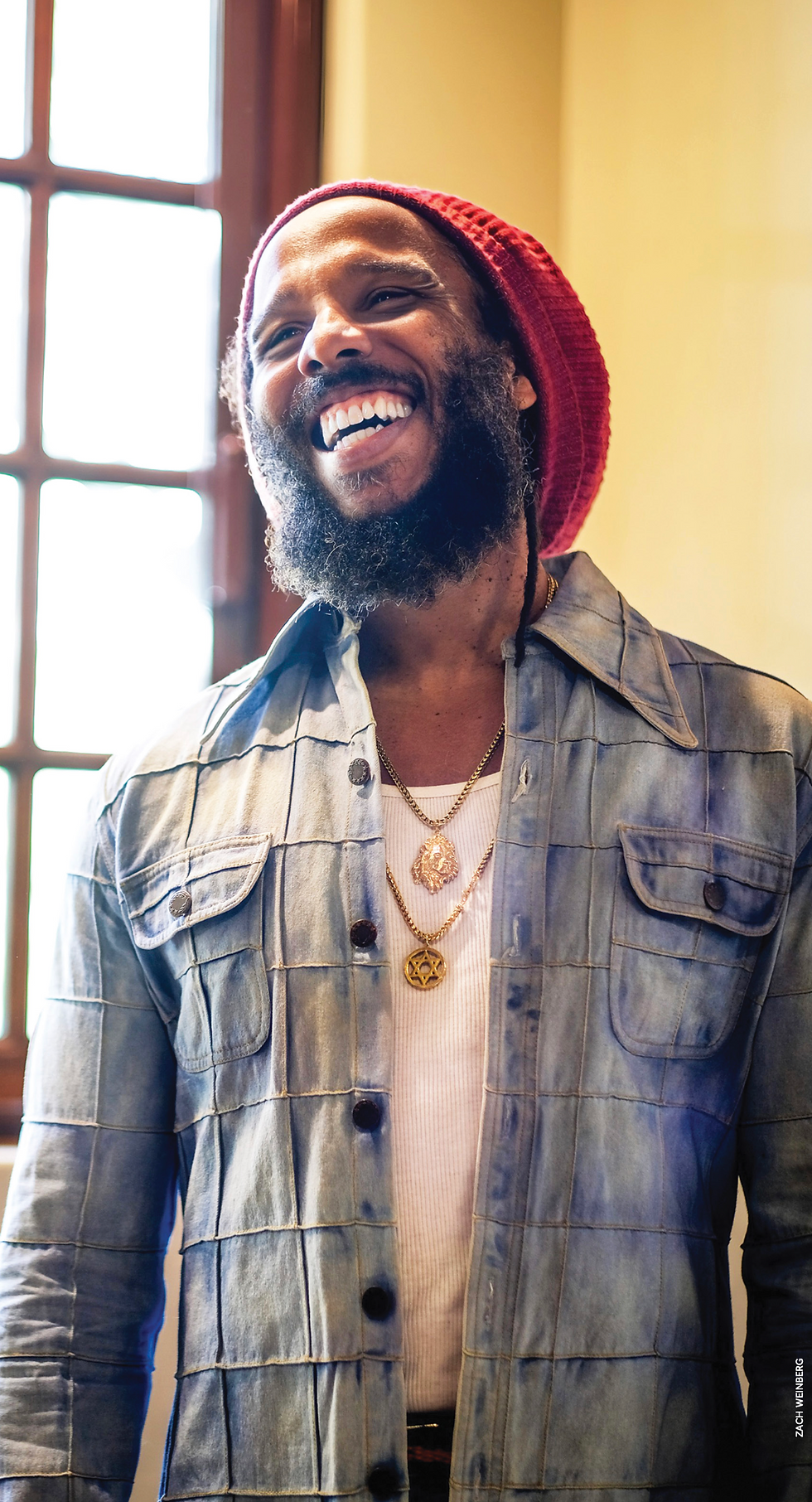
SHERMAN: You’re going to be performing this summer at Tanglewood. What excites you most about bringing reggae into a setting that is so deeply rooted
in classical music?
MARLEY: Music is music. What we really think about is bringing a message. Over the years, I’ve done festivals—rock festivals, hip-hop festivals, all kinds of festivals. It doesn’t matter. The message, the spirit, and the vibrations are universal.
SHERMAN: Brightside is your first studio album in several years. What felt different about this creative cycle compared to your past recordings?
MARLEY: I went into this album very, very sure of what I wanted. We rehearsed the band prior to recording the tracks, which is different. And we decided to make this record as if there were no digital world. We recorded this record for vinyl. So, that made it fresh and new, which was exciting.
SHERMAN: Healing, compassion, and optimism are celebrated throughout Brightside. So many people are not optimistic these days. It was really refreshing to hear your music and feel good.
MARLEY: Yeah, well, I’m not optimistic some days either. And that’s why these songs came out the way they did, because I needed something to lift me out of my funk. A lot of these songs deal with that funk, but they do it in such a way that it’s not about the down feeling. If you listen to my words, you can hear my humanity, my being fragile to what’s going on around me and in the world. A lot of the songs I wrote on this record were to help me get out of that downward spiral. There are two sides to every story. I’m choosing to always look on the bright side, because there’s always a bright side. There’s always a negative, and there’s always a positive. Where we focus our energy is what will lead us where we want to go. And I feel like in the world today— in the media, in politics, in culture—there is a lot of negativity. We’re not hearing a lot about the bright side. So, this music is acknowledging that, but it’s also about finding a way out of it.
SHERMAN: The single “Many Mourn for Bob” from the album acknowledges sadness, but it also seems to focus on celebrating life. Can you talk a little bit about revisiting your father’s legacy through that lens?
MARLEY: I think the first spark for that song was my memories of the funeral we had in Jamaica, and seeing the kids on the street, and just so much emotion. Then I watched back the video of the whole thing, and it brought back a lot of memories and emotion. And doing the One Love movie, where we tried to show Bob’s emotional side—the suffering he went through, not even as a star, but asa human being. We tried to address that. And I think that brought back some kind of understanding, an emotional connection to what he was going through, beyond him being my father and beyond him being this legend that people see him as. And then, I’m an older person now—much older than he was when he passed away. [Ziggy is 57 years old; his father died at 36.] In some ways, I feel sorry for him that he didn’t get to live life more. It’s sad. He went through a lot personally that is not public, that you don’t see. When people listen to songs, they might not hear it. Some of his songs that are not the most popular—if you dive deeper into them—he expresses that emotional hurt that he’s feeling. I think I connected with that as a human being and as a man. When I was doing “Many Mourn for Bob,” I literally said to myself, “This could be a song my father would sing himself. This could be his song.” It’s like a collaboration—a Ziggy Marley and Bob Marley collaboration in the spiritual sense.
SHERMAN: You’ve worn many hats over the years: artist, producer, label owner, author, philanthropist. How do you feel those different roles inform one another in your day-to-day creative life?
MARLEY: I’m a sponge. I’m a student. I’m always learning. The last big experience I went through was the movie, being on set every day and seeing how that works. And I feel like that had a real effect on me. First of all, I love movies. But being on a movie set, there is a creative energy there, and because I am who I am and my brain works how it works, all of that goes into my subconscious. This record is the first time I really thought about music being visual. And I think it’s because of the experience of the movie, that creative energy. It became part of my psyche: visual music and sounds that create a visual.
SHERMAN: I’d like to specifically ask you about running Tuff Gong Worldwide, which gives you control over your masters and publishing, and therefore a certain amount of independence that a lot of artists don’t have. How has that independence influenced the way you approach releasing and creating music?
MARLEY: Let me give some context and history: When I was growing up around my father and mother, they were always trying to be independent business people from the beginning. I always heard them talking about getting out of contracts, finishing the last contract, and starting to do their own thing. I always saw my father working toward that. So, they instilled in me that independent spirit. Bob didn’t get there, but that dream never died. That dream lived on with me—not just because it was his dream, but because it became my dream, too. And I saw the benefits of being free. We always talk about freedom. This is our mantra: “Freedom.” As a youth and asa teenager, that meant a lot to me: to be free, to be independent. I didn’t start out independent. I went through some labels and stuff. But then I moved to LA, and after the last record with a label, it was like, “Why do I need a record label? Why do I need one right now? I can do it myself.” So that’s when I started doing it myself and putting out my records. Especially now, with the technology and the state of the industry, unless you’re trying to chase dollars, you really can doit by yourself. And then I met my wife, and she’s one of the smartest women I know. My father had my mother; I have my wife. If you have a good partner beside you, it works much better. She really helped me figure out the business side of the whole independent thing. Someone asked me the other day, “What are the necessary evils in the music industry?” And I told them, “I don’t have any necessary evil because I’m independent.” I don’t have to sell myself. I don’t have to be sexy. I don’t have to do anything that I don’t want to do. There’s no necessary evil for me, because I’m free. And yes, I’m privileged to be in that position. Not everybody can be in that position, but I am. And it’s been working out great for me. It’s not about the hype. It’s not about the shine. It’s not about trying to get as many records sold or as many streams. It’s the quality of what I put out—something that lasts lifetimes, that lasts generations. Not just a thing that comes and goes. Because we’re not chasing fame; we’re chasing quality.
SHERMAN: The music industry is experiencing a major moment of change because of AI. I believe in technology, but I believe more in the creativity of human artists. Can you talk a little bit about what humans bring to music that AI can’t?
MARLEY: Soul. AI has no soul. And experience in life. It doesn’t have that. It just takes information. It doesn’t have its own experience of things. So yeah, it can’t speak to my soul. It can speak maybe to my ears, maybe to my body, but it can’t speak to my heart, because it’s not coming from reality. It’s not coming from a real experience. It’s coming from things it takes. So, I think that’s the difference with AI for me. And to tell the truth, a lot of the kids in the future may not even know, may not even understand, until they hear an old record and realize that it feels different. They’ll say, “Hold on—there’s something here.” A hundred years from now, some kid is going to be listening to AI music, and then they’re going to find an old record and say, “What is that? Oh my God. Do you feel that?” It’s a whole different feeling.
Ziggy Marley and Trombone Shorty & Orleans Avenue will perform at Tanglewood’s Koussevitzky Music Shed on Tuesday, July 14, at 7 p.m. tanglewood.org


Comments